Replacing Harty and Leysdown Pumping Stations – Delivering resilient infrastructure in a constrained landscape
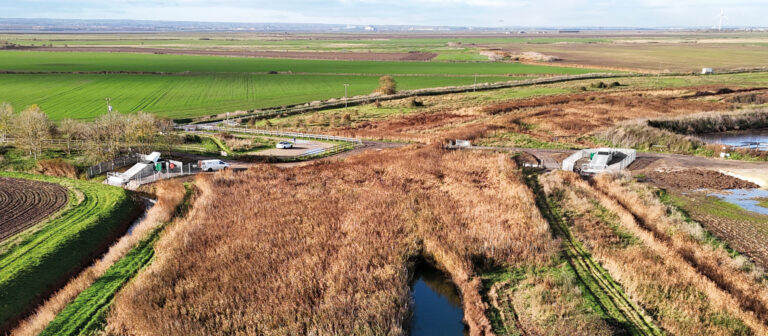
Harty and Leysdown are two pumping stations located on the Isle of Sheppey in Kent. They serve two low lying catchments that are entirely reliant on pumped drainage. The land they protect includes productive agricultural holdings and internationally designated freshwater grazing marsh, supporting significant populations of breeding and overwintering birds.
Both pump stations were built in the 1970s, and in recent years their reliability had deteriorated significantly. Harty failed during the winter of 2019/20 requiring emergency pumping and a 24 hour site presence for several weeks while levels remained high. The experience underlined what we already knew, continual patch repairs were no longer a sustainable strategy.
Lower Medway Internal Drainage Board had long identified a need for replacement, but funding was a constraint. The Board had prudently built reserves towards the project, yet there remained a substantial shortfall. Although properties exist within the protected catchments, neither scheme could attract sufficient Flood Defence Grant in Aid to make delivery viable under the usual partnership funding model.
The breakthrough came through a successful application to Defra’s Tranche 2B (Asset Improvement) element of the IDB Storm Recovery & Asset Improvement Fund. That funding, combined with the Board’s own reserves, enabled the project to proceed. It is a good example of targeted central support unlocking locally developed schemes that might otherwise remain undelivered for some time.
Working within environmental and physical constraints
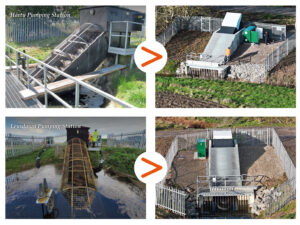 At concept stage, several key constraints shaped the approach. Firstly, flood protection had to be maintained throughout the works, with limited space to construct entirely offline replacements. Both sites lie partially within The Swale National Nature Reserve, designated as a Site of Special Interest (SSSI), Special Protection Area (SPA), Special Area of Conservation (SAC) and Ramsar site. The working window for intrusive works was narrow, broadly June to October, subject to ongoing bird surveys. Furthermore, the locations are remote, with constrained access for construction and potential implications for highway upgrades and culvert works.
The core requirements for the new installations were clear: energy efficient pumps with long service lives, adaptability to future climate pressures, safe eel passage, minimal habitat disturbance, and reduced whole life carbon footprint.
Rethinking the traditional approach
Traditionally, replacing a land drainage pumping station involves sheet piling and extensive cast-in-situ concrete works to form pump support structures and working areas. On constrained, environmentally sensitive sites, those activities can drive both programme risk and cost.
The detailed design prioritised minimising site works wherever reasonably practicable. On a remote site with ecological constraints and a narrow working window, reducing plant movements and construction activities lowered delivery risk and cut embodied carbon through reduced material and temporary works requirements.
For Harty and Leysdown, the design team – Stantec, working collaboratively with ACE, and precast supplier JKH, developed a prefabricated concrete support structure. The units were designed specifically around the selected pumps and auxiliary equipment, modularised for transport and assembled on site.
Once the concept was fixed, foundations were designed in collaboration with Breheny Civil Engineering. Cased concrete piles were installed using a small piling rig, which allowed the foundations to be delivered with minimal plant machinery. Beyond that, the civil works were deliberately modest: minor earthworks, scour protection, a control kiosk, electrical ducting, drainage, fencing, and hardstanding.
Works commenced in June 2024 following ecological clearance and resolution of power supply issues. Foundations were installed first. Both prefabricated support structures and pumpsets were then installed within a three-week period. Civil works were completed by October 2024, exactly four months from commencement, comfortably within the ecological window. Residual mechanical & electrical works followed, and both stations were brought online in November. Crucially, flood protection was maintained throughout, with no requirement for emergency pumping during the works.
Cost and carbon outcomes
Early cost comparisons indicated that the prefabricated approach to the pump support structure was approximately half the cost of a cast-in-situ equivalent. The savings were driven by reduced material quantities. In addition to the savings associated with reduced construction materials, there were substantial cost and carbon savings associated with the avoidance of: infrastructure upgrade works, temporary works including dewatering, a prolonged site presence, and the associated contingency risks. Environmental and flood risks were also greatly reduced.
Modern pumping technology
Both stations are equipped with modern screw pumps selected for their fish-friendly design, and the new installations incorporate variable speed drives and telemetry, providing far greater control of water levels, and enabling a more energy-efficient pumping regime. For an IDB operating increasingly complex water management duties, that level of operational control is invaluable.
A model for wider adoption
There are many low to medium capacity pumping stations across the country facing similar challenges: ageing assets, constrained sites, environmental sensitivities, and limited funding. The approach taken at Harty and Leysdown demonstrates that modern methods of construction, combined with early contractor collaboration, can materially change the delivery model.
Projects can be delivered more quickly, with lower capital cost, and reduced whole-life carbon, while maintaining environmental safeguards and operational resilience. For IDBs managing entirely pumped catchments, where asset failure carries immediate consequences, accelerating replacement programmes in a cost-effective way is essential.
For the newly amalgamated North Kent Marshes Water Level Management Board, this scheme represents more than a like-for-like replacement. It marks a shift in delivery philosophy; one we intend to refine as lessons are embedded into future projects. With improved control and telemetry now in place, the next logical step is to work more closely with landowners to optimise how water is retained and reused within the catchment, making better use of the resource that is being pumped while maintaining flood resilience.
In a funding landscape where every pound must work harder, innovation in design and construction is not optional. It is fundamental to maintaining resilient water level management in our most vulnerable landscapes.
The success of this approach was recognised, when the project was shortlisted for the Best Project – Innovation category in the Institution of Civil Engineers (ICE) South East Engineering Excellence Awards 2024. It highlights how modern methods of construction and collaborative design can reshape delivery of relatively modest, but operationally critical, drainage assets.
 Within a month of completion, water voles had returned to areas around both pumping stations, a quiet but welcome sign of aquatic life continuing alongside essential infrastructure.
By Priscilla Haselhurst, Chief Officer, North Kent Marshes Water Level Management Board – First published in the ADA Gazette, Spring 2026
For more information about North Kent Marshes Water Level Management Board, or to follow and support their work, visit their website at www.northkentwlmb.org.uk
Categories
Archive
- September 2026
- August 2026
- July 2026
- May 2026
- April 2026
- March 2026
- February 2026
- January 2026
- December 2025
- November 2025
- October 2025
- July 2025
- June 2025
- March 2025
- February 2025
- January 2025
- December 2024
- November 2024
- October 2024
- September 2024
- August 2024
- July 2024
- June 2024
- May 2024
- April 2024
- March 2024
- January 2024
- December 2023
- November 2023
- October 2023
- September 2023
- August 2023
- July 2023
- June 2023
- May 2023
- April 2023
- March 2023
- February 2023
- January 2023
- December 2022
- September 2022
- August 2022
- July 2022
- June 2022
- May 2022
- April 2022
- March 2022
- February 2022
- January 2022
- December 2021
- November 2021
- September 2021
- July 2021
- May 2021
- March 2021
- February 2021
- January 2021
- December 2020
- November 2020
- October 2020
- September 2020
- August 2020
- July 2020
- May 2020
- April 2020
- March 2020
- February 2020
- January 2020
- December 2019
- November 2019
- October 2019
- September 2019
- August 2019
- July 2019
- June 2019
- May 2019
- April 2019
- March 2019
- February 2019
- January 2019
- December 2018
- November 2018
- October 2018
- September 2018
- August 2018
- July 2018
- June 2018
- May 2018
- April 2018
- March 2018
- February 2018
- January 2018
- December 2017
- November 2017
- October 2017
- September 2017
- August 2017
- July 2017
- June 2017
- May 2017
- April 2017
- March 2017
- February 2017
- January 2017
- October 2016
- September 2016
- August 2016
- July 2016
- June 2016
- May 2016
- April 2016
- March 2016
- January 2016