Drought exposes the growing challenge of managing water in England’s lowlands
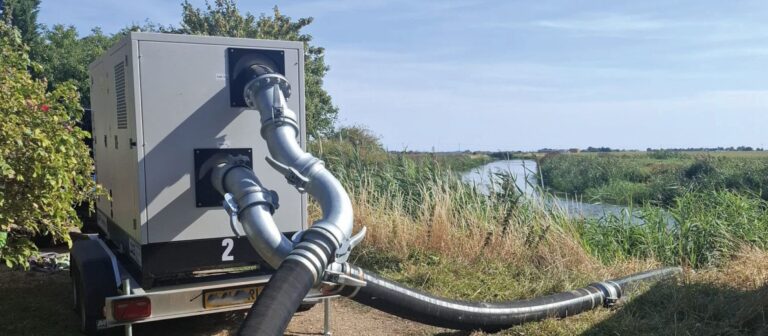
An eight-inch mobile pump being operated by the Middle Level Commissioners to transfer water into the Holmewood & District IDB system during the Holme Fen National Nature Reserve Fire (Jon Fenn)
England’s latest long, hot summer has brought the country its third drought in five years and the driest July in almost two centuries. The effects have been especially acute across the lowlands, where farmers, regulators and internal drainage boards (IDBs) must balance scarce water supplies, environmental protection, and the needs of food production. The season has shown that IDBs’ water level management role now depends as much on retaining and distributing water as it does on draining land during wet periods.
In the Fens, IDBs are working closely with local Environment Agency officers as prolonged dry weather and low river flows have resulted in severe abstraction restrictions. Abstractors around the South Level whose licences include the Denver condition faced a full cessation from 11 July, after voluntary restrictions failed to halt falling water levels. A similar cessation began in the Middle Level on 27 July. Abstraction restrictions arrived at the peak of the irrigation season, when crops were most dependent on reliable supplies.
A gap in the water-management toolkit
The restrictions underline a growing gap in the water-management toolkit: storage. More agricultural reservoirs and strategic IDB storage reservoirs would allow water to be captured when it is available and used when river flows are under pressure. At district level, IDBs can also help retain water safely within watercourse networks, manage levels and improve distribution. This is a significant shift in emphasis for organisations historically associated with flood defence, but one that increasingly reflects the realities of a changing climate.
Dry weather creates new risks
The Netherlands offers a warning about the wider consequences of prolonged drought. Water boards there have carried out extra checks along thousands of kilometres of dikes and watercourse embankments to identify cracks and other damage caused by dry weather. Such inspections are particularly important before wetter conditions return. Dried-out soils absorb intense rainfall less effectively, so the end of a drought can itself increase flood risk rather than provide an immediate return to normal.
Prolonged sunshine, high temperatures, and low river flows have also created perfect conditions for rapid aquatic weed and algal growth across many of England’s waterways this summer. Warm weather accelerates photosynthesis and heats up slow-moving water, but most significantly nutrient levels, primarily phosphorus and nitrogen from agricultural runoff and wastewater, have become more heavily concentrated as river levels ran exceptionally low.
A long road to recovery
Recovery is likely to take time. Restoring normal river flows and groundwater levels requires prolonged, above-average rainfall, and low levels may persist for months even after the weather becomes unsettled, as it may well do in a stronger than average El Niño year. Climate change also makes repeated extremes more likely, challenging assumptions on which current systems were designed. A future strategy must therefore retain more water within lowland landscapes, align planning and development with water availability, improve users’ resilience and continue to optimise distribution.
For Jon Fenn, Head of Water Level Management at the Middle Level Commissioners (MLC), the 2026 season was defined by communication and cooperation. The MLC acts as a conduit between supplies from the Lower Nene and local abstractors, requiring continual coordination with the Environment Agency, Anglian Water and farming representatives. Communication at operational level improved markedly, helping partners understand the difficult decisions required as conditions deteriorated.
Meetings before the irrigation season gave newer Environment Agency colleagues insight into the MLC’s water-level operations and the narrow 200mm working band within which the system is managed. In the summer, the MLC system effectively acts as a large linear reservoir. Engagement with the National Farmers’ Union also strengthened understanding of why water management decisions are taken in a pumped lowland system. These relationships matter because drought management is more nuanced and prolonged than flood response: pressure can continue across a six-month irrigation season rather than during a short, intense storm event.
A system operating close to its limits
The season also exposed a structural imbalance. Fenn estimates that, after unused licences are discounted, the MLC system may be over-licensed by around a third. Aggregate licensed abstraction could be about 180,000 cubic metres per day, compared with a maximum intake through Stanground of roughly 150,000 cubic metres per day—and that maximum depends on favourable operating conditions. The result is a potential daily deficit of about 30,000 cubic metres when demand is highest.
Modern abstractors use efficient pumps and machinery that can operate around the clock, while larger businesses can deploy teams to move pipes day and night. By contrast, many control structures are old, approaching the end of their working lives and costly to replace. Compliance remains essential too. During drought, intelligence shared with the Environment Agency can help identify abstraction outside licence conditions, protect those users who follow the rules and mitigate the environmental risk to the MLC and IDB systems.
The Holme Fen test
The sharpest pinch point came when a peatland fire broke out on the Holme Fen National Nature Reserve near Peterborough. This was declared a national Major Incident. Abstractors were already limited to irrigation on four nights a week, yet every available resource was offered to support the firefighting water supply by both Holmewood & District IDB and the MLC. For two weeks the incident dominated operational meetings and demanded exceptional collaboration. It demonstrated how quickly drought can turn a constrained water-resource system into an emergency service lifeline, while normal agricultural and environmental demands continue.
At the peak of firefighting activity there were more than 100 fire fighters on site, with portable HV pumps alongside numerous smaller agricultural irrigation pump sets being used to dampen the site. Combined they were abstracting circa 40,000l/min from the IDB system, which necessitated the deployment of the large capacity pump to supplement intake via the IDB’s gravity feed.
An eight-inch mobile pump purchased by the MLC through the IDB Storm Recovery & Asset Improvement Fund was utilised. The mobile pump was transported, set up and run by MLC on site for almost two weeks. It provided additional pumping capacity to transfer additional volumes of water from the Old River Nene (an MLC managed watercourse) into the Homewood & District IDB main pumping drain towards the fire site.
The fire also showed abstractors and IDBs coming together. North Level District IDB and the Nene Washes generously ceased their own abstraction from the Lower Nene Abstractors Group to bolster dwindling supplies for the Holme Fen fire fight during a time of great stress on their own water resource situation. The Environment Agency deployed high-volume pumps to the Dog in a Doublet Sluice to transfer water from the tidal Nene back into the Lower Nene.
The response came at a cost. The MLC estimates that managing water resources this season required £120,000–£150,000 in operational expenditure, with the response costs to the fire in addition. That position is difficult to sustain as droughts become more frequent and water retention infrastructure needs grow. The experience strengthens the case for a clearer long-term role—and an appropriate funding model—for IDBs that retain and manage water safely, regulating levels and distributing scarce supplies across their districts.
By Ian Moodie, ADA – First published in the ADA Gazette, Autumn 2026
Categories
Archive
- October 2026
- September 2026
- August 2026
- July 2026
- May 2026
- April 2026
- March 2026
- February 2026
- January 2026
- December 2025
- November 2025
- October 2025
- July 2025
- June 2025
- March 2025
- February 2025
- January 2025
- December 2024
- November 2024
- October 2024
- September 2024
- August 2024
- July 2024
- June 2024
- May 2024
- April 2024
- March 2024
- January 2024
- December 2023
- November 2023
- October 2023
- September 2023
- August 2023
- July 2023
- June 2023
- May 2023
- April 2023
- March 2023
- February 2023
- January 2023
- December 2022
- September 2022
- August 2022
- July 2022
- June 2022
- May 2022
- April 2022
- March 2022
- February 2022
- January 2022
- December 2021
- November 2021
- September 2021
- July 2021
- May 2021
- March 2021
- February 2021
- January 2021
- December 2020
- November 2020
- October 2020
- September 2020
- August 2020
- July 2020
- May 2020
- April 2020
- March 2020
- February 2020
- January 2020
- December 2019
- November 2019
- October 2019
- September 2019
- August 2019
- July 2019
- June 2019
- May 2019
- April 2019
- March 2019
- February 2019
- January 2019
- December 2018
- November 2018
- October 2018
- September 2018
- August 2018
- July 2018
- June 2018
- May 2018
- April 2018
- March 2018
- February 2018
- January 2018
- December 2017
- November 2017
- October 2017
- September 2017
- August 2017
- July 2017
- June 2017
- May 2017
- April 2017
- March 2017
- February 2017
- January 2017
- October 2016
- September 2016
- August 2016
- July 2016
- June 2016
- May 2016
- April 2016
- March 2016
- January 2016